
Reflections on a decade of British brewed New England IPAs

“I genuinely believe that these kinds of beers are going to change the way that beer is made in the future and it’s going to bring a lot more people into the craft beer world.”
Jonny Garrett – The Craft Beer Channel, First taste of Gipsy Hill Drifter, YouTube, 27th April 2016.
When future historians sit down to write the authoritative history of British beer in the 21st century they will have many crucial years to focus on, in just the first quarter of their timeline.
2002 is obviously important, for the government’s introduction of the Progressive Beer Duty, which opened the door to the microbrewery boom. 2007 could be analysed for the founding of Brewdog and the official starting gun being fired on the “craft beer revolution”. 2015 is notable for being the year of the first major UK craft brewery sellouts (Meantime to SABMiller & Camden to ABInbev). Of course, 2020 is also bound to be pivotal, with the Covid-19 pandemic and its subsequent fallout. However, if I were writing the book, I would be tempted to pick 2016 as a key chapter, as this was the year that the New England IPA style reached our shores. It was the year that Britain went hazy.
In 2016 I was managing, what was then called, the Red Squirrel Brewery Shop in Berkhamsted, a posh commuter-belt market town in Hertfordshire. The Red Squirrel shops were a hybrid model, part specialist beer off-licence, part bar, a combo which isn’t uncommon now, but back then was quite forward thinking. As well as a healthy stock of our own brewery’s beers on tap and in bottle, we also stocked an impressive range of small-pack from other breweries near and far. Our range fluctuated, but would normally be around 150 different beers on the shelves at any one time, most of which were from UK breweries.
Looking back at the beers we stocked in 2013-2016 it is clear to see, with hindsight, that British breweries were throwing everything at the wall and trying to find out what would stick. Yes there were a lot of IPA’s, but these were generally of the resin and grapefruit heavy variety. Brutish IBU bombs that clawed at your face. The term “West Coast” wasn’t in common use, back then American IPA was sufficient. There was also plenty of the standard expected styles like stouts, bitters, pales, etc. But we also used to get a huge variety of what might be easiest to describe collectively as “niche” brews. Time & Tide’s beetroot hefeweizen “Root of all Evil” had a cult following in the shop, as did Celtic Brewery’s “Home of the Fruitcakes”, a strawberry saison. Mad Hatter’s Tzatziki Sour sold out as fast as it was bought in. There were esoteric takes on wits and altbiers, rye beers, clean sours, and blondes. Core ranges varied wildly from brewery to brewery. Canopy, a south London startup, whom we stocked immediately, launched their brewery with a permanent 7.2% Belgian Amber ale. Brew By Numbers 01|01 was a hoppy saison. The only thing that varied more than the styles available was the quality of the output. A few beers were remarkable, many were fun for one, huge swathes were, in hindsight, not great.
In April 2016, Cloudwater released V3, the third instalment in their DIPA series. The first Cloudwater beers had been released a little over a year before and the brewery had built significant hype from day one. V1 and V2 didn’t make their way down to our corner of the Home Counties, but they had gained enough fervour that V3 was hotly anticipated. It was hard to get, but we managed to secure 24 bottles for the shop. To make it fair, we limited it to one per customer, no reservations or preorders. It sold out within a couple of hours. The beer was completely opaque orange, low in bitterness, full bodied, soft in mouthfeel and bursting with citric, tropical and stone fruit character. It was like nothing else we had stocked. It was like nothing else I had ever tasted.
Cloudwater DIPA V3 was one of the first New England style IPAs to be brewed and released in the UK. The New England style had originated in Vermont in the states in the early noughties and was increasingly gaining favour, so it was only a matter of time before the style crossed the channel. There is some contention about who brewed the actual first ever New England IPA in the UK. A couple of breweries claim to have produced one before 2016, however I would argue that Cloudwater V3 was the first one to have any significant cultural impact.The first beer released in the UK specifically labelled as a New England IPA, was “Drifter” a collaboration between Gipsy Hill and The Craft Beer Channel which came out just a few weeks after V3 and was documented over several of the channels YouTube episode.
Cloudwater followed V3 with “Threes Company” a collab with Magic Rock and JW Lees; a New England IPA fermented with the JW Lees house ale yeast. Quickly after that was DIPAs V4 & V5, a simultaneous release. Each one of these releases was a huge success and sold out almost instantly. For the V4 & V5 release day we had punters queueing outside, ready for the shop to open at midday and get their bottle. It was the only time that ever happened. The hype was real.
By the end of summer 2016, new East Coast/Vermont/New England style hazy IPA’s were beginning to appear from other leading UK craft breweries. Those we could get hold off always sold very well. It was becoming apparent that many breweries were looking at these early adopters and making their own plans to integrate the style into their portfolio. For the next 12 months the ‘haze craze’ was like a snowball rolling down a hill, it was unstoppable and getting bigger by the day. It felt like every single brewery was suddenly doing a New England, with each successive brew claiming to be juicier and cloudier than the last. New breweries, such as Deya and Verdant (who both existed before 2016 but found success after), started to gain traction with decidedly New England centric offerings. Some breweries began to quietly drop some of their more European influenced brews in favour of hazy IPAs loaded with hops such as Citra, Mosaic and Idaho-7. By the following summer our range at the shop had become dominated by them. Not only had the New England IPA taken off, but in its wake other styles changed; pale ales got hazier, APAs got lighter in colour and less bitter. Very quickly, various iterations of hazy pales and IPAs were taking the lions share of shelf space. That is not to say that niche styles of beer weren’t still available from UK producers, but they definitely became far fewer and harder to source. After all, why would a brewery risk releasing a grisette, when a tropical hop bomb would definitely sell faster?
Even for my then employers, this logic became clear. At the start of 2017 the brewery and shops rebranded to Mad Squirrel, the core beers $UMO and Hopfest (a APA and pale ale respectively) got deliberately hazier and less bitter. By the summer of 2017 Roadkill, a 6.5% New England IPA had joined the range. Mad Squirrel are still going today and the majority of their output continues to focus mostly on hazy style IPAs and pales.
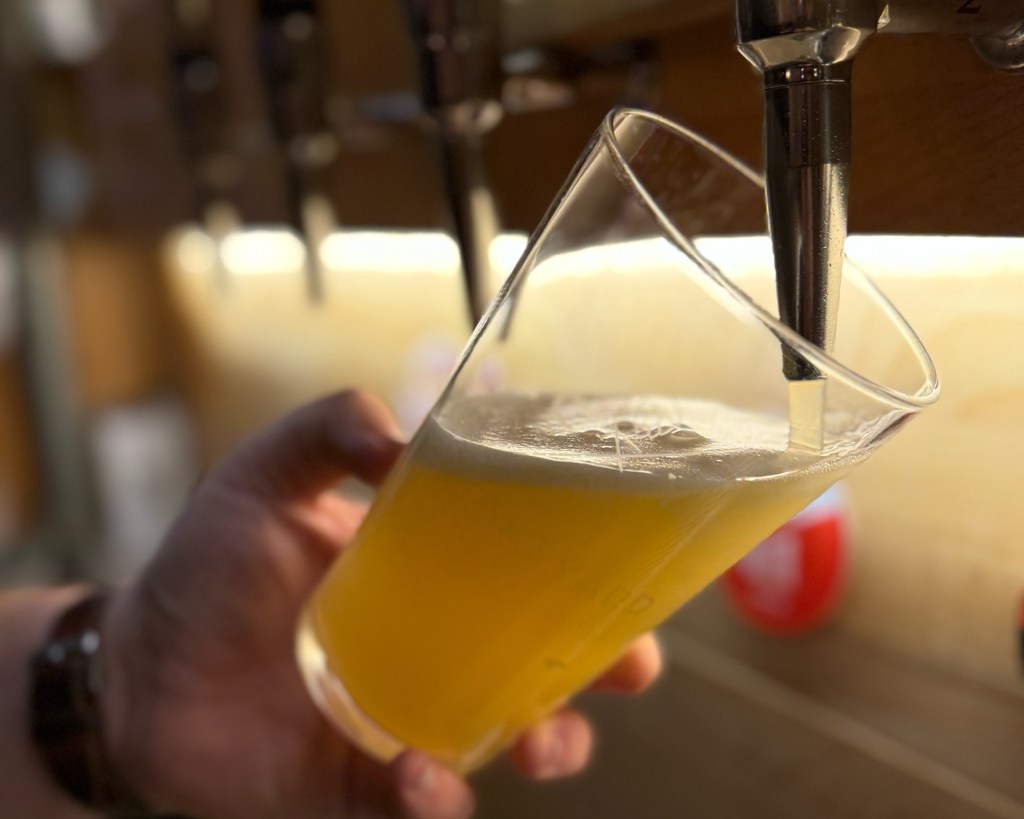
For the next couple of years the New England craze felt all encompassing, at least in craft beer circles. Whilst sales represented a tiny fraction of the overall UK beer market, the cultural presence of the style and its offshoots seemed to be growing at an exponential rate. This was, in part, due to the magnification of social media. Whilst Twitter and Facebook both played their part, it was Instagram, the the fastest growing social media platform from 2016-2018, that was the front line. It was awash with photos of luminous opaque yellow glasses, sometimes with soft cloud like head, sometimes poured ‘iceman’, that is, filled right to the brim, headless.
There was always some push-back though. Some breweries never stopped producing the bitter, piny and sharp citric IPAs, and a couple, such as Weird Beard of London made a point to not follow the trend at all, shunning hazy IPAs altogether. Towards the end of 2018 the hybrid ‘no coast’ style, AKA Mountain IPA emerged from the US and found its way into British brewing repertoires. The Mountain IPA is an interesting middle ground. In these brews a New England appearance and mouthfeel is matched with a hop profile, and specifically a bitterness level, more akin to a West Coast. Perhaps this could be interpreted as a sign of some early onset juice fatigue amongst some brewers, but there was no dampening on the enthusiasm of drinkers. New England style pales, IPAs and Double IPAs continued to rapidly grow in popularity.
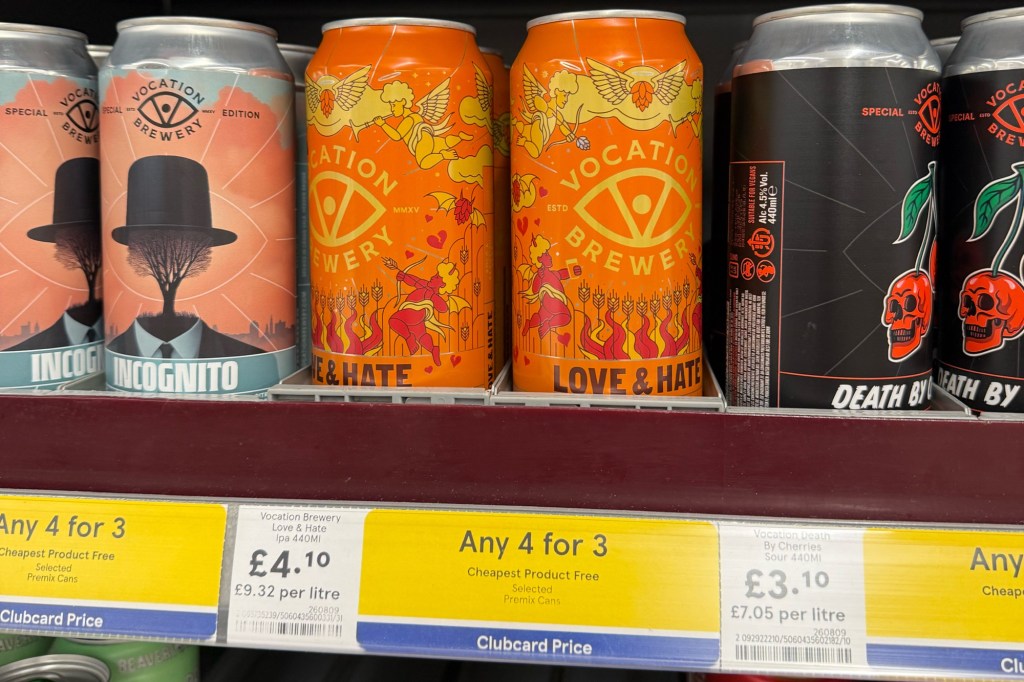
The hype didn’t go unnoticed by even the most traditional of British brewers. In November 2017 Fullers, London’s oldest and largest brewery released a limited edition box set called “Fullers and Friends” which contained six beers brewed in collaboration with some of the UK’s leading craft breweries. Within the mix was a 7% New England IPA, brewed with Cloudwater. A few months into 2018 Adnams of Southwold, released a limited edition NEIPA, complete with Vermont yeast, as part of their seasonal range. Supermarkets too were keen to get in on the action. By September 2018 Tesco was stocking Vocation’s Love & Hate nationally. The listing proved controversial in the online craft beer forums of the time, with hardened hop fans unconvinced that the quality would hold-up within a nationwide supply chain. However, demand is louder than concerns, and hazy IPAs have continued to hold a place in all the major supermarkets beer offerings ever since. Love & Hate has remained a permanent listing in Tesco and has, since 2018, sold more than a million cans.
Due to the fact that the majority of volume was distributed in small pack, rather than draught, the momentum of the category was not hindered by the Covid-19 pandemic. Whilst pubs shuttered and taprooms closed, small breweries pivoted to online retail and kept fresh cans flowing to thirsty furloughed drinkers up and down the country. Once the pubs finally, fully, reopened without restrictions in summer 2021 many mainstream operators found a demand for hazy IPAs and pales that had not registered pre-pandemic. This opened the door for some of the more commercially savvy craft breweries to get listings in large regional and national pub groups with their more accessible offerings. Beers such as Deya’s Steady Rolling Man, and Northern Monk’s Faith have found audiences well beyond craft taprooms due to strategic listings and partnerships with much bigger operators.
However, for every brand that now has national recognition there are still plenty of other haze makers out there supplying their local markets. New England styles still make up a considerable offering in the independent beer shops and bars around the country and cult breweries like Baron, Rivington and Floc have built a strong following off the back of their dedication to the style.
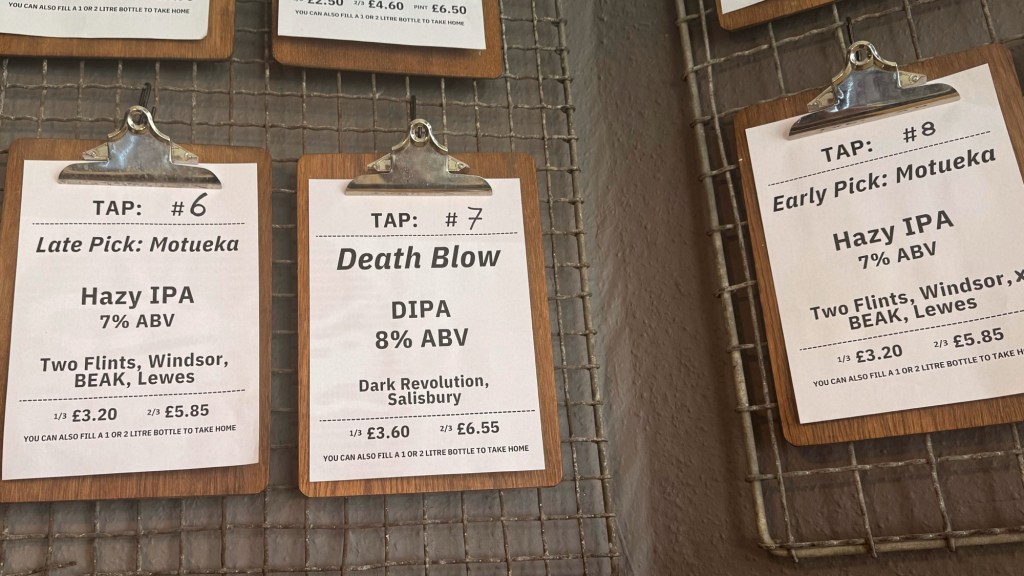
Those first New England IPA releases in the UK are now a decade into the past. After ten years we are able to look back and see how their impact has changed beer within this country in a number of different ways.
Prior to 2016 there was no mainstream acceptance of cloudy beer in this country. The Campaign for Real Ale (CAMRA), Cask Marque and the traditional ale breweries, had successfully educated the common drinker that good cask ale was always crystal clear, however this belief was the common consensus across drinkers of all beer categories. It would be incorrect to claim that hazy beers didn’t exist before New England, they most definitely did, but they weren’t prevalent, outside of craft pockets like the Bermondsey Beer Mile. Even selling a classic hefeweizen on tap in the early 2010’s was met with heavy scepticism and derision by the majority of our customers in the Home Counties. Fast-forward ten years and hazy beers have mainstream acceptance across most operators and many beer categories. Not only do most breweries have a hazy keg offering of some description, un-fined cask has become increasingly common, and even major lager brands like Stella Artois and Birra Moretti have launched unfiltered, cloudy versions of their brews to tap into the audience, at least aesthetically, if not flavour wise. Hazy, as a visual trait, is definitely here to stay.
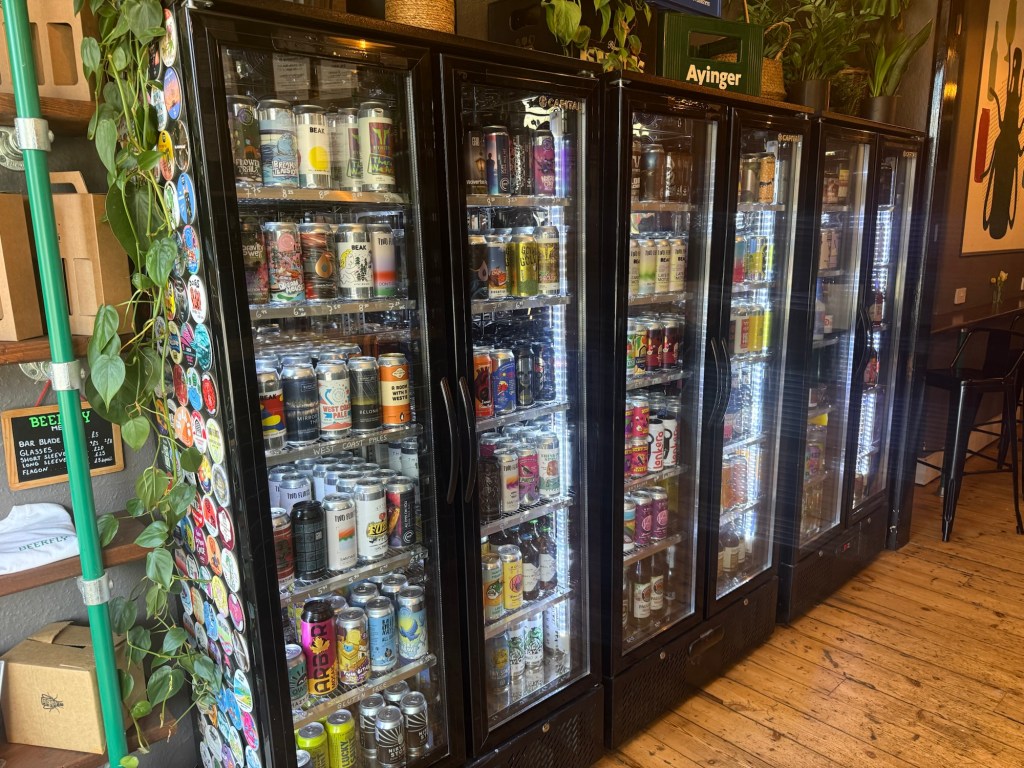
New England IPAs also forced many operators and distributors to sit up and take refrigeration seriously for the first time. A decade ago the vast majority of physical beer stockists were storing beers of all varieties on shelves and in warehouses at ambient temperatures. NEIPAs are one of the most temperature sensitive styles. The hops fade fast and those fresh bright fruit notes can quickly be reduced to a muddled, stale mess if stored warm. The popularity of the category, and its drinkers fixation on freshness, has encouraged the widespread adoption of fridges in even the smallest of craft beer shops.
There is also the impact on the fortunes and appreciation of other beer styles. All movements and developments within beer are a reaction to what has come before, either by building upon the past or contradicting it. There is an argument to be made that styles such as the milkshake IPA or the modern smoothie beers wouldn’t exist without New England coming first. Likewise Brut IPAs and Cold IPAs can be seen as a direct reaction against East Coast prevalence, just as East Coast itself was a direct reaction against West Coast dominance.
Perhaps what is most interesting, and most uniquely British though, is the link between the style and the faring of cask ale. Much of the language of New England, shares a commonality with that of cask ale. Tasting notes describing “soft mouthfeel”, “lower carbonation” and “yeast-driven esters” could belong as easily to Best Bitters as NEIPA. Whilst West Coast IPAs generally use the most flavour neutral yeast strains like the “Chico”(US-05), the Vermont yeast strains that went into early New Englands shared much more characteristics with traditional English ale yeasts, with more ester driven fruit notes and lower attenuation. For two categories of beer that have been set against each other in media narratives, they actually have plenty in common. This could maybe explain the uptick in interest in cask ale and traditional British ale styles in the last couple of years. In 2016, and for several years after, the New England hype was seen as a direct contributor to casks ongoing decline, however it now seems to be a sponsor for its revival. Many hazy brewers have turned their hand to traditional cask styles in the last few years, mostly with great success. There is a definite trajectory between the IPA drinkers of 2016, now being the cask ale enthusiasts on 2026, myself included.
The naysayers of the mid 2010’s lambasted New England IPAs as a fad. Ten years since the style crossed the Atlantic, it is fair to conclude this isn’t the case. Whilst I think we may have now seen the cultural high water-mark for the style in the UK, a constant trickle of new hop varietals, new breweries, and new brewing tweaks are enough to keep the style prevalent in British craft beer circles. Supermarket listings and accessible brands feed new drinkers into the top of the styles funnel, whilst bottle shops and taprooms service the dedicated fans at the other end. There is a significant subset of beer drinker who focus almost solely on these types of beers zealously.
When I host guided tastings with the general public, it is often the New England IPA that appeals most to participants who wouldn’t consider themselves as a conventional beer drinker. As a style it does have that wow-factor that can open people’s eyes to the incredibly wild possibilities of what beer can taste like. For every 2018 ‘haze-bro’ that is now more excited about perfectly sparkled pints of cask bitter, there is someone having their mind blown by New England IPA for the first time. A decade in, we can be confident that it has brought a lot more people across these isles into the craft beer world. The haze is here to stay.
 Beer with Tim
Leave a comment